Your garage door uses one of two spring systems — torsion or extension. They do the same job (counterbalance the weight of the door so the opener doesn't have to lift the full 200+ pounds) but the engineering is fundamentally different. Knowing which you have matters for safety, maintenance, and replacement cost.
The Quick Identification
Look above and behind your door when it's closed:
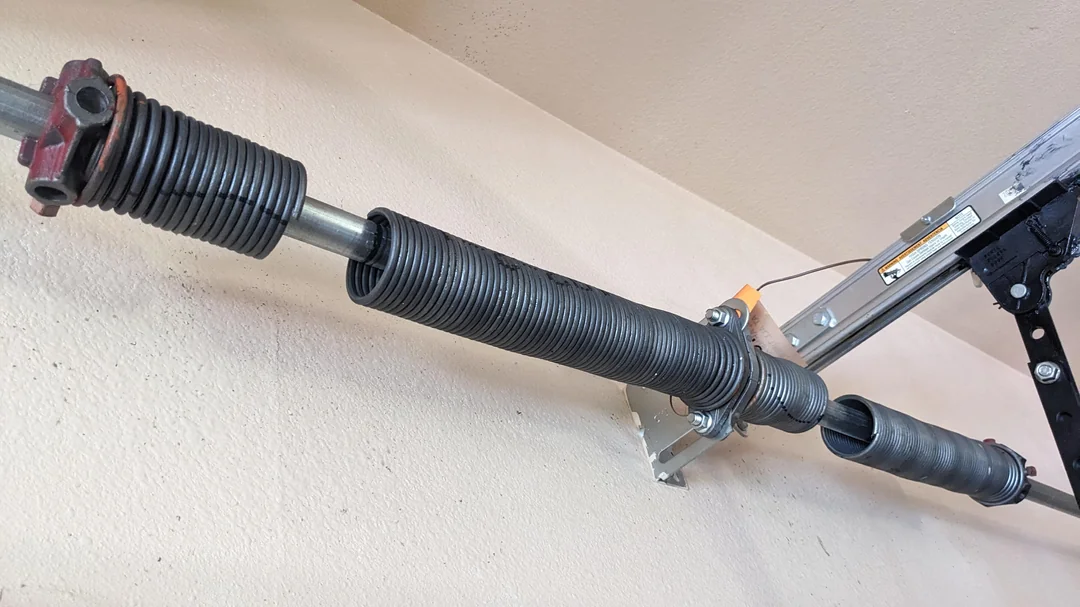
Torsion springs: Mounted horizontally on a shaft above the door opening. Usually one or two long springs wound tight, with bracket-mounted cones on each end. Most doors built in the last 25 years use these.
Extension springs: Mounted along the horizontal tracks (the ones running from the wall back into the garage ceiling). They look like long coiled springs running parallel to the tracks, with safety cables threaded through them. Mostly found on older doors (pre-2000) and very lightweight single-car doors.
If you can't see springs at all when the door is closed, you have torsion. If you see them running parallel to the ceiling tracks, extension.
How Each System Works
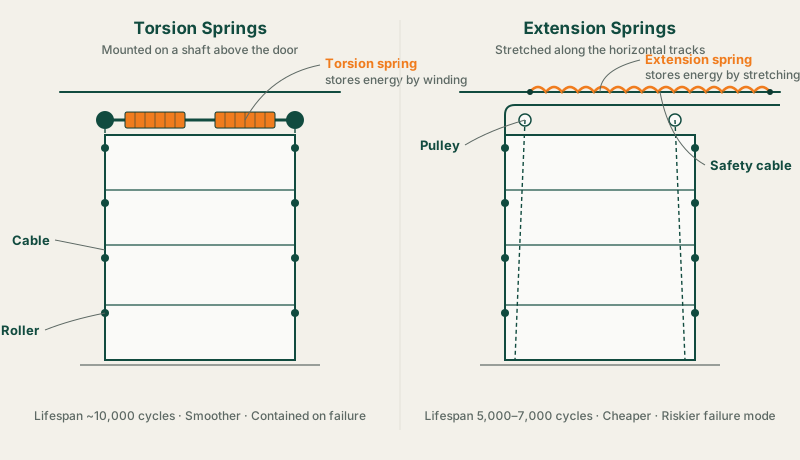
Torsion: springs are wound to store energy. When the door descends, weight winds the spring tighter (storing energy). When the door rises, the spring unwinds (releasing energy to lift the door). The energy is delivered through cables wrapped around drums mounted on the spring shaft.
Extension: springs stretch when the door is closed (stored as tension), and contract when the door opens (releasing energy). The energy is delivered via pulleys and cables routed along the tracks. Each spring works on one side of the door independently.
Which Is Better?
For most homeowners, torsion is the better system across the board:
| Factor | Torsion | Extension |
|---|---|---|
| Lifespan | 10,000+ cycles (7–12 yrs) | 5,000–7,000 cycles |
| Smoothness | Even, balanced lift | Can be jerky, especially side-to-side |
| Safety on failure | Spring contained on shaft | Can release violently if it breaks |
| Door weight capacity | Up to 600+ lbs | Up to ~300 lbs |
| Repair cost (pair) | $350–$520 installed | $150–$280 installed |
Extension springs are cheaper to replace but more dangerous and shorter-lived. If you have extension springs and they're failing, ask about converting to torsion during the repair — it's $200–$400 over a basic spring replacement, and typically pays back within 5–7 years.
When Extension Springs Make Sense
Despite the disadvantages, there are cases where extension is the right choice:
- Very low headroom garages (less than 6″ of clearance above the door)
- Some sectional roll-up doors
- When repair cost is the only consideration and the door is otherwise near end-of-life
The Safety Cable Rule
If you have extension springs, you must have safety cables — heavy cables threaded through the center of each spring. If the spring breaks, the safety cable contains the broken pieces so they don't become projectiles.
Federal code has required safety cables since 1993 on new installs, but many older systems don't have them. If yours doesn't, install them immediately — they cost $30–$60 and could save someone's eyesight.
This is also true after any extension spring repair: the cable should be re-threaded through the new spring before reinstallation. Some inexperienced techs skip this step. Always ask.
Replacement Rules (Both Types)
Torsion springs:
- Always replace in pairs on doors with two springs (even if one looks fine)
- Match wire size, length, and inner diameter exactly to original
- Weigh the door — wrong-sized springs put the door out of balance immediately
- High-cycle springs (25,000+ cycles) cost ~$80 more but last 2–3x longer
Extension springs:
- Replace in pairs even on opposite sides (matched fatigue prevents an unbalanced door)
- Re-install or upgrade safety cables at the same time
- If your door uses a single extension spring (rare), strongly consider converting to a balanced two-spring system
DIY Risk Reminder
Both spring systems are under massive stored energy. Torsion springs at full pre-load store ~200–300 lbs of force. Extension springs at full stretch carry 150–200 lbs. Either can cause serious injury when handled incorrectly. See why you should never DIY a garage door spring for the unflinching version of why this isn't a weekend project.
The DFW Lifespan Reality
Standard 10,000-cycle springs are rated for cycle count — 7–12 years for typical residential use. DFW summer heat above 100°F accelerates fatigue, so plan for the lower end. If your springs are 8+ years old and you haven't had a replacement, preventive replacement makes economic sense — same cost as emergency, no surprise breakdowns.
Cost Summary
| Repair | Installed |
|---|---|
| Single torsion spring | $220–$320 |
| Both torsion springs (recommended) | $350–$520 |
| Extension springs (pair, with safety cables) | $150–$280 |
| Convert extension to torsion | +$200–$400 |
| High-cycle torsion upgrade | +$80 per spring |
For the full pricing picture across all common services, see our DFW cost guide. For full maintenance routine, see our checklist.
The Steward Approach
Every spring service call includes a complete inspection: we weigh the door, measure existing springs, check cables and drums, and write out the full price before doing the work. We never replace a single spring on a dual-spring door without explaining why — and we never recommend an upgrade you don't need.