If your garage door is 10+ years old, you're looking at a piece of 2014 technology. A lot has changed. Some of the changes are real, durable improvements you'll feel every day; others are gimmicks in marketing clothing. Here's an honest tour of what's actually new in garage doors in 2026 — and what's worth paying extra for.
Where the Real Changes Have Happened
The last decade of garage door evolution sorts cleanly into three buckets:
- Smart connectivity — Wi-Fi, app control, voice assistants, status alerts
- Materials and design — full-view glass, faux-wood finishes, hybrid steel-aluminum frames
- Performance and safety — better insulation, quieter drives, smarter sensors, battery backup
Some of these matter on any home. Others only make sense if you're already replacing the door or opener anyway.
1. Smart Openers Quietly Became the Default
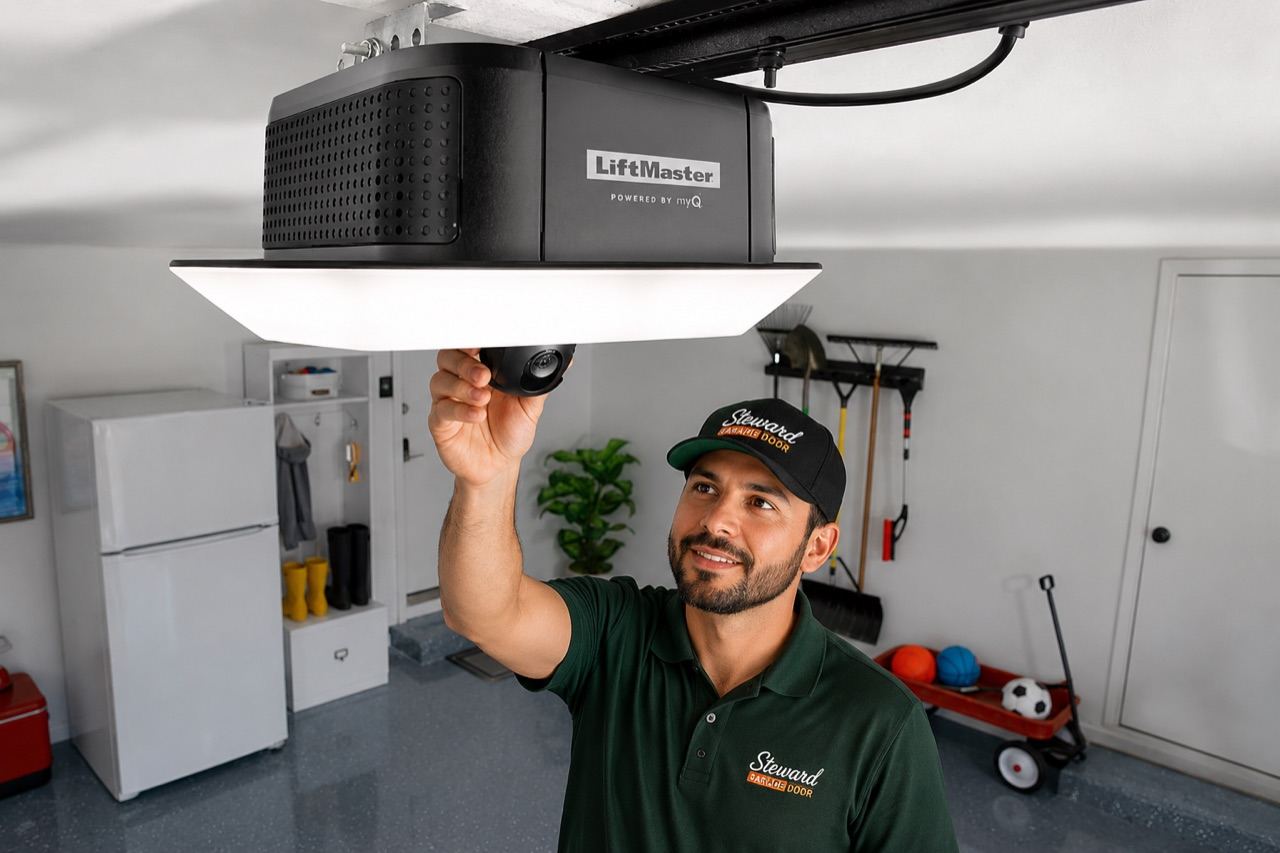
Five years ago, a “smart” opener was a premium upcharge. In 2026, it's standard on virtually every opener over $400. Three platforms dominate what you'll actually find on store shelves:
- MyQ (LiftMaster, Chamberlain) — the leader. Integrates with Amazon Key, Google Home, and added Apple HomeKit support in 2025.
- Aladdin Connect (Genie) — capable, simpler interface, lower price ceiling.
- Sommer Pro — niche but excellent on premium direct-drive installs.
Genuinely useful: alerts when the door cycles, status check from anywhere, letting service workers in remotely, and home-automation routines (auto-close after 30 minutes open, lights on when door opens after dark).
Mostly marketing: AI package detection (works half the time — buy a real garage camera instead), built-in opener cameras (lower image quality than dedicated units), “door auto-opens when you arrive” (more annoying than useful in practice).
2. Battery Backup Goes Standard
California now legally requires battery backup on every new opener sold. Manufacturers don't make state-specific lines anymore, so the same battery-backed units are available everywhere. Given Texas' grid history — the 2021 Uri freeze, routine summer outages — this is the single most useful $80–$120 add-on most DFW homeowners will buy. A backed-up opener gives you 20–50 cycles during an outage, which is the difference between leaving the house and being stranded.
For the full opener picture, see our garage door opener buying guide.
3. Full-View Glass Doors Move Beyond Modernist Homes
The biggest aesthetic shift of the past few years is the full-view glass door — aluminum frames with tempered or frosted glass panels, designed for daylight and visibility. They started on modernist new builds and have spread to:
- Garage gym conversions
- Workshop spaces that want natural light
- Higher-end home renovations
- Showroom-style detached garages
Real talk: they're $4,500–$9,000 installed vs. $1,500–$3,500 for a standard insulated steel door. Stunning when they fit the architecture. On a traditional brick ranch home, they look out of place — and the summer heat gain in Texas can be uncomfortable if you spend time in the garage.
4. Faux-Wood Finishes That Actually Look Convincing
Real wood carriage doors run $5,000–$15,000+ and need refinishing every 3–5 years. The new generation of faux-wood steel doors solves both problems. Modern printing techniques produce wood grain that's hard to distinguish from real cedar or mahogany at 10 feet — and the door is still steel underneath, so it's $2,500–$5,000 installed and zero maintenance.
If you've been priced out of a wood carriage look, the 2026 faux-wood doors are the genuine value pick. See signs you need a new garage door for when the upgrade makes financial sense.
5. Insulation: A Quiet Major Upgrade for Texas
Older garage doors had R-values of 0–4 (essentially none). Modern insulated doors range from R-9 (basic) to R-20+ (premium polyurethane-injected). For DFW homes with bedrooms or living space above or beside the garage, the difference is real:
- Less summer heat transfer: a 130°F garage becomes a 105°F garage
- Quieter operation: insulation also dampens the door's mechanical sound
- Lower HVAC bills if the garage is attached to conditioned space
Upgrading to an R-16+ insulated door typically adds $400–$800 vs. uninsulated. For most DFW homes that's a 2–3 year payback in comfort alone.
6. Smarter Safety: The Auto-Reverse Got an Upgrade
Infrared photo-eye sensors have been federally required since 1993 and they're not going anywhere. What's new in 2026:
- Force-detection thresholds adjustable in 1% increments — fewer false reverses on cold mornings when the door's a little stiff
- Self-diagnostic firmware that tells you when sensor alignment has drifted, instead of just failing silently
- Visible status lights on the opener itself so you can tell sensor faults apart from logic-board faults at a glance
These are quietly the biggest reliability improvements of the past decade. For more on door safety, see our family safety check.
7. Quieter Drives Across the Board
Modern belt-drive openers run at roughly 50 decibels — about conversational-voice volume. Direct-drive jackshaft units run closer to 35 dB, quieter than a refrigerator. If your bedroom is over the garage and you're hearing the chain rattle every morning, this is the upgrade you'll feel daily. Our noisy garage door guide covers cheaper interim fixes if you're not ready to replace the opener.
8. Hybrid Steel-Aluminum Materials
The interesting hybrid for DFW is steel doors with aluminum frames — the strength of steel with corrosion resistance and lighter weight (sometimes 20% lighter overall). Lighter doors mean less wear on the opener, longer spring life, and easier manual operation during outages. The trade-off is a $200–$400 premium over a comparable all-steel door.
What's Actually Worth Upgrading For
If you're not yet replacing the whole door or opener, the upgrade math is straightforward:
| Upgrade | Worth it if… | Typical Cost |
|---|---|---|
| Battery backup (add-on or new opener) | You live anywhere in Texas | $80–$120 add-on |
| Belt-drive opener replacement | Bedrooms above the garage + noisy chain | $400–$575 installed |
| Insulated door | Garage borders conditioned space or you use it as workshop/gym | +$400–$800 over uninsulated |
| Wi-Fi / smart opener | You're already getting a new opener anyway | Usually $0 (built in) |
| Faux-wood carriage door | Existing door is failing AND curb appeal matters | $2,500–$5,000 installed |
| Full-view glass door | Modern architecture, garage is a featured space | $4,500–$9,000 installed |
What's not worth chasing mid-cycle: adding cameras, AI features, or HomeKit integration to an opener that already works. These are nice-to-haves on a new install, not justifications for early replacement. See our repair-or-replace guide for the broader decision framework.
The Steward Take
The biggest meaningful innovation of the past decade is the combination of battery backup plus a properly-sized belt-drive opener with rolling-code security. That bundle runs $475–$600 installed, and it genuinely transforms the day-to-day experience of using the door — quieter mornings, reliable function during outages, no anxiety about the door being left open.
Everything else — glass doors, faux-wood, premium insulation, smart-home integration — is a question of whether you're replacing the door anyway. If you are, the right time to add the upgrades is now (they cost meaningfully less bundled into a new install than retrofitted later). If you're not, no single innovation is dramatic enough to justify early replacement.
If you want a no-pressure look at what makes sense for your home, we do free in-home consultations with written recommendations and installed pricing before any commitment.