Your garage door is the heaviest moving object in your home — 150–250 pounds for a standard double-car door, more for insulated or wood. When something fails, the consequences range from a dented car to serious injury. The U.S. Consumer Product Safety Commission reports an average of 30,000 garage-door related injuries each year.
The good news: 90% of those injuries are preventable with three basic tests you can run in 10 minutes. Here's the family safety check we recommend every DFW homeowner do twice a year.
The Five-Minute Safety Test
Test 1: The 2x4 Reverse Test
Lay a flat 2x4 board on the floor under the door. Close the door with the opener. The door must reverse on contact with the board. Federal law has required this since 1993; if your door doesn't reverse, it's unsafe to operate until adjusted.
What fails this test:
- Force settings on the opener are too high (adjustment fix)
- Worn or stuck closing-limit switches
- Logic-board fault on older openers (10+ years)
Test 2: The Photo-Eye Sensor Test
Look at the two small sensors mounted 4–6 inches off the floor on each side of the door. Both indicator lights should be steady — usually green on one side, red or amber on the other.
While the door is closing, wave a broom through the beam path near the floor. The door must reverse.
Common failures we see in DFW:
- Dust accumulation on the lenses — wipe with a soft cloth
- Spider webs or insect debris (more common in spring)
- Misalignment from being bumped — loosen the wing nut, realign until both lights are steady, retighten
- Wiring damage from yard work or trimmer line
Test 3: The Balance Test
With the opener disengaged (pull the red manual release cord), lift the door halfway by hand. A balanced door stays where you put it. A door that drops or shoots up has springs out of adjustment — and an opener straining every cycle.
An out-of-balance door isn't immediately dangerous, but it accelerates the failure of every other component. And when a spring breaks under load, that is dangerous.
The Two-Minute Walk-Around Inspection
After the three tests, do a visual scan:
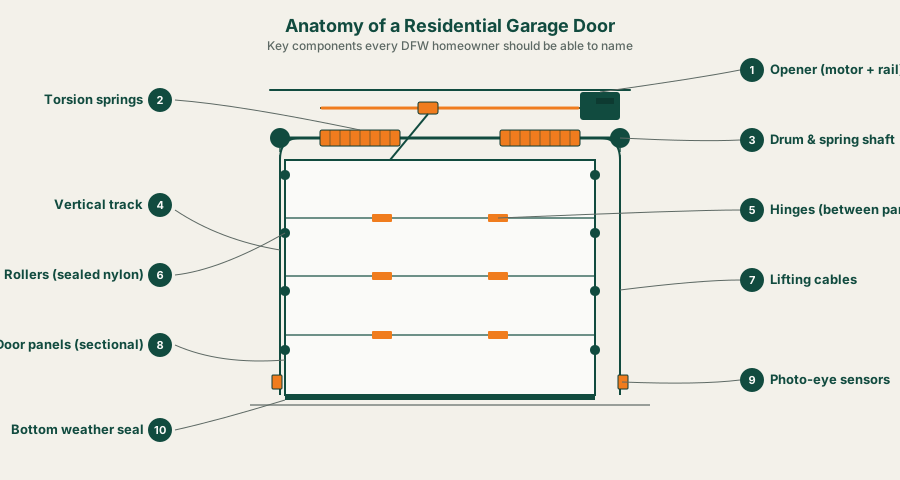
Cables and springs: Look for fraying on cables and visible gaps in spring coils. Any of these = stop using the door, call us. Cable and spring repairs are never DIY — see why you should never DIY a garage door spring.
Bottom bracket: The bottom brackets are under spring tension. Look for cracks or warping. Never try to remove them yourself.
Tracks: Tracks should be plumb and straight. Bent tracks usually indicate vehicle impact — even a minor one.
Weather seal: A cracked bottom seal lets DFW dust, pests, and storm water into the garage. Cheap to fix ($85–$160).
Childproofing Your Garage Door
Three things every family with children should do:
- Mount the wall control button at least 5 feet high — out of children's reach. Modern building code requires this on new installs.
- Teach kids the door is not a toy. The CPSC specifically warns against riding or hanging on garage doors. Most pediatric garage-door injuries come from this.
- Lock remotes when traveling. Modern openers have a vacation/lockout switch — use it. Old non-rolling-code remotes can be cloned with $20 of equipment.
The DFW Factor
Texas heat affects safety systems in specific ways:
- Photo-eye sensor lenses crack at higher rates than in milder climates — inspect yearly
- Bottom seals deteriorate faster from UV exposure
- Springs cycle through wider temperature ranges, which accelerates fatigue
- Dust storms knock sensors out of alignment more often
We recommend safety checks in March (post-winter) and October (pre-cold-snap) for DFW specifically.
When to Call vs. Fix Yourself
Safe DIY: cleaning photo-eye lenses, tightening loose hardware, replacing remote batteries, lubricating with garage-door-specific lube.
Always call a pro: anything spring-related, anything cable-related, bottom-bracket issues, a door that fails the 2x4 test after sensor cleaning, any visible damage to panels or tracks.
The 10-Year Replacement Rule
Photo-eye sensors and force-detection circuits in openers degrade over time. If your opener is 10+ years old, the safety systems aren't performing at the level a new unit would — even if they pass tests today. Response time and reliability slip year over year. Upgrade timing decisions are covered in our opener buying guide.
The Steward Promise
Every Steward service call includes a free safety inspection — we test auto-reverse, sensors, balance, and springs as part of any visit. If something fails, we tell you what it costs to fix. You decide what to do next. For the full twice-a-year maintenance routine, see our checklist.